
 Jonathan Black

We recently took “Advice for Life”, a six-part JLI course that applies Jewish teachings to business and life. Its lessons on work, rest, health and adversity apply as much to running a business as to living well. These are our takeaways.
The importance of work
Work provides meaning
Work offers the opportunity to make your most meaningful impact – through the people it connects you with, whom you would otherwise never meet, and through the results of your efforts.
Work provides responsibility
Work is how you support others – your employees, your family, or both.
Rest is crucial
Judaism teaches that you should disengage completely once a week, on Saturdays. Many successful entrepreneurs make the same point about “detoxing” and protecting their mental health: Netflix co-founder Marc Randolph made a point of switching off every Tuesday afternoon.
Judaism goes further, arguing that the break is not just a way to recover – it is key to success. Just as rest helps you see faster progress in the gym, stepping away helps you perform better at work.
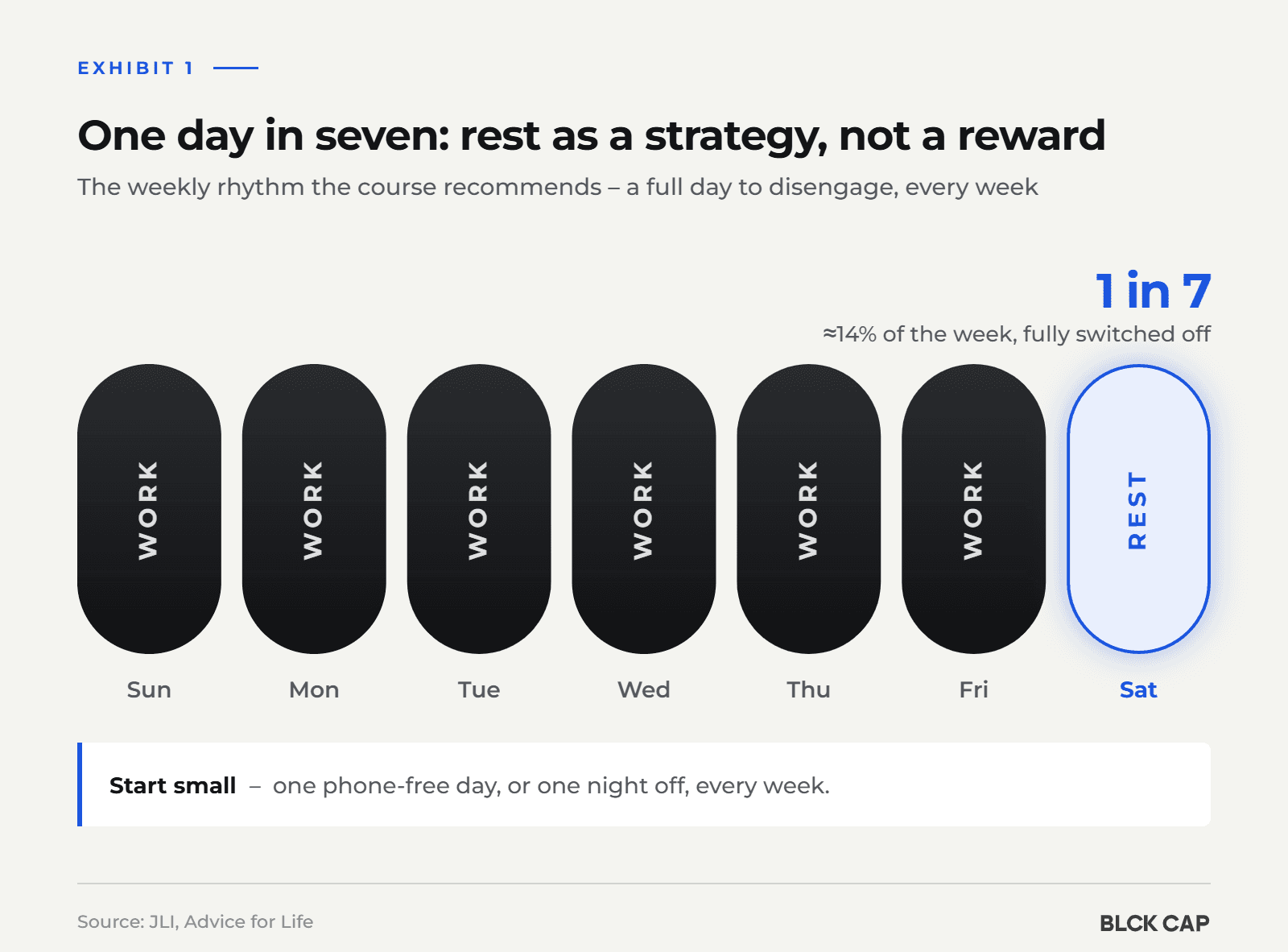
Start small: try not to use your phone one day a week, or take one night off a week.
Work allows you to give
Work gives you the means to give back. Judaism teaches giving 10% of all income to charity – and that, in return, it will bring you great wealth. The idea is common across the world: “the more you give, the more you receive”. When you go into business, the course suggests, you give a 10% share to God in the form of charity.
The language makes the point too. In Hebrew, the word for ten (עשר) shares its root with the word for rich (עשיר) – and so it is taught that by giving 10% to charity, you will become wealthy.

Work and faith are intertwined
All work relies on faith. Whether you are building a rocket to go to Mars, making an investment, building a product or opening a bakery, you are taking a leap of faith. On the return of one of SpaceX’s rockets, founder Elon Musk famously said: “I’m not religious, but I prayed for this one.”
Judaism encourages you to trust that your needs will be provided for – without neglecting hard work. In stressful times, there is real comfort in believing that the outcome of your efforts is part of a bigger plan.
Work and family
Keep in perspective what you are working for. Set aside time every day to speak with your family.
Never fully retire
Maintain a purpose in life. Don’t work yourself into the grave, but never lose your purpose: there is no life without it.
Wealth has its own challenges
Affluence brings challenges of its own – people treat you differently, for example – but they are preferable to the challenges of poverty.
Physical health
Physical health is as important as anything else in Judaism. Without it, you cannot function.
Form versus function. Asked to choose between form and function, most people – unless they are arguing about fashion – would say that function wins. Judaism argues that the two are equally important: the world was created with both, so both carry equal weight. Applied to health, your body is your “form” and your soul is your “function”, so you need to work on your physical health just as much as your spiritual health.
Mind affects matter. Be positive. Research increasingly links a positive mindset with better health – Johns Hopkins Medicine highlights a study in which people with a positive outlook were less likely to suffer from heart disease.
Stay engaged. Productivity and engagement can ease physical discomfort. You can help someone who is unwell by giving them work or tasks to focus on.
Mental health and anxiety
Forget about it. To tackle a mental problem, dismiss it for a while; you will return to it with a fresh perspective. The mind is constantly in flux, and tends – consciously or not – to drift back to whatever you are trying to put aside.
Engage elsewhere. Find other things to absorb your attention: work, family and friends, sport. The more you think about a problem, the bigger it becomes.
Keep perspective. Focus on your life, not on the anxiety in your mind.
Dealing with adversity
Everything is for the best
There is a story about a man called Nachum Ish Gamzu (נחום איש גמזו) – literally “Nachum, the also-this man”. He earned the name because, whatever happened to him, he would respond: “Gam zu letovah” (גם זו לטובה) – “this too is for the best”.
Gam zu letovah – this too is for the best.
The lesson is to believe that everything that happens, however difficult it seems at the time, is ultimately for the best. In Jewish belief, everything in the world happens because of God, and as God is good, whatever happens is good.
It is close to the idea of “when life gives you lemons, make lemonade” – except that, rather than making the best of a bad situation, the idea is that there is no bad situation. That does not mean passively accepting whatever comes your way; it means believing there is an ultimately good purpose behind every event.
Strength from adversity
Adversity reveals inner strength. Judaism teaches that suffering has a purpose, and that overcoming challenges leads to greatness. Jensen Huang, CEO of NVIDIA – one of the world’s most valuable companies – was recently quoted wishing hardship on young graduates, in the hope that it would help them succeed.
What we are taking back to work
Protect one day a week to switch off – and start small if you need to.
Give generously; it is part of doing business, not separate from it.
Treat faith in the outcome as fuel for effort, not a substitute for it.
Look after the body as seriously as the work.
When things go wrong, look for the purpose – and the strength it reveals.
This article reflects the author’s personal notes and reflections from JLI’s six-part “Advice for Life” course, and was first published on 10 June 2024. It is shared for general interest only and does not constitute professional, medical or financial advice.